
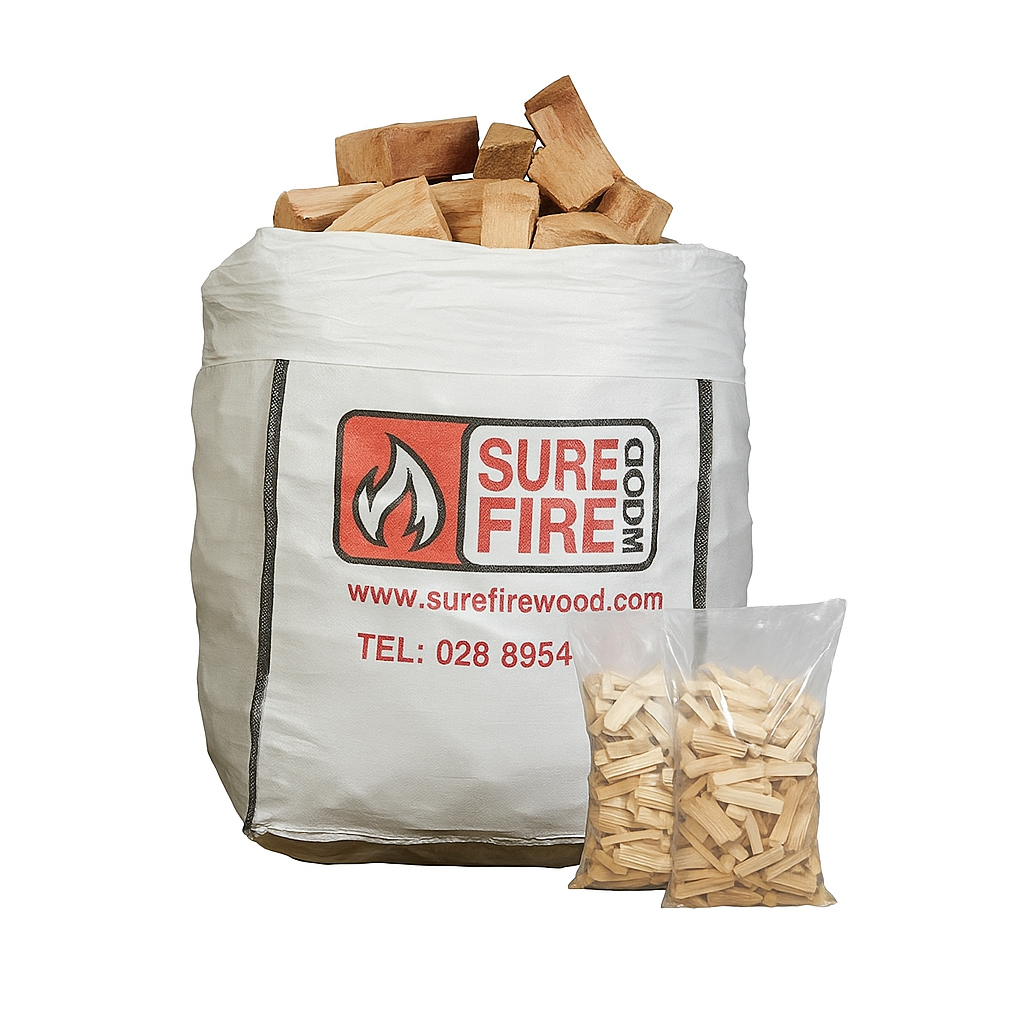
How Long Does a Bag of Firewood Last? A Practical Guide for Ireland
One of the most common questions when ordering firewood is:
How long will a bag of logs actually last?
It's a sensible question, especially if you're trying to work out how much firewood you'll need to get through an Irish autumn and winter.
Unfortunately, there isn't one simple answer.
A bag that lasts one household several weeks could disappear much more quickly in another.
It depends on your stove, how often you light it, how many hours you burn each day, the type of firewood you're using and, importantly, how dry your logs are.
Here's how to get a much more realistic idea of how quickly you'll use your firewood.
Quick Answer: How Long Does a Bag of Logs Last?
Rather than expecting a bag of firewood to last a fixed number of days or weeks, it's better to think about how often you use your stove and how many logs you typically burn.
Someone who lights their stove for a couple of hours on occasional evenings will use far less firewood than someone running a stove for most of the day.
The weather makes a difference too.
A mild evening in October is very different from a cold January night.
That's why claims that a particular bag of firewood will last a specific number of weeks should always be treated cautiously.
What Determines How Quickly You Use Firewood?
Several factors can make a significant difference.
1. How Often You Light Your Stove
This is probably the biggest factor.
If you use your wood-burning stove once or twice a week, your supply will naturally last considerably longer than someone lighting theirs every evening.
If your stove is used every day, or wood provides a significant amount of your household heating, you'll need a much larger supply over the course of winter.
Before ordering, think realistically about how you use your stove.
If you're trying to calculate your requirements for the whole heating season, read our How Much Firewood Do I Need? Complete Guide.
2. How Many Hours You Burn Each Day
Two households might both say they use their stove "every day", but that doesn't mean their firewood consumption will be anything alike.
One household might light the stove at 7pm and allow it to go out a few hours later.
Another might light theirs during the morning and keep it burning well into the evening.
The second household will clearly require considerably more firewood.
This is one of the main reasons it's difficult to give an accurate answer when someone asks how many days or weeks a bag of logs should last.
3. Your Stove Size
The size and output of your stove can also affect how quickly you get through your logs.
A small stove heating one room has very different requirements from a larger appliance heating a substantial open-plan area.
Correct stove sizing matters too.
If you're constantly pushing a small stove hard because it's undersized for the space you're trying to heat, you may find yourself refuelling frequently.
Always follow your stove manufacturer's instructions regarding suitable fuel, loading and operation.
4. The Type of Firewood You're Burning
Not all logs behave the same way.
Wood species vary considerably in density.
Dense hardwoods such as Oak, Ash and Beech generally provide a more sustained burn.
Quality softwoods such as Larch and Spruce are less dense but can provide excellent responsive heat, making them particularly useful when you want to establish a fire and bring your stove up to temperature quickly.
This doesn't mean one is simply "good" and the other "bad".
They behave differently and can suit different types of stove use.
If you've always been told that you shouldn't burn softwood in a stove, have a read of our Can You Burn Softwood in a Wood-Burning Stove? guide.
5. Moisture Content Makes a Big Difference
One of the most important things to consider when buying firewood is how dry it actually is.
There's little value in buying a large volume of firewood if a significant proportion of the energy produced by your fire is being used to drive moisture from the logs.
Wet wood can be harder to light, produce more smoke and provide less useful heat.
At Surefire Wood, our firewood is professionally kiln dried to below 20% moisture content.
In Ireland, the moisture content of firewood is particularly important, with current rules applying to wood fuels sold for domestic burning.
If you'd like to understand the subject properly, read our Complete Guide to Firewood Moisture Content.
Put simply:
You're buying wood — not water.
6. How You Operate Your Stove
Two people using identical stoves and identical firewood can still consume different quantities.
How you light the fire, control the air supply and refuel all affect the rate at which logs are consumed.
Closing the air controls too aggressively isn't necessarily an effective way to make your logs last longer.
A smouldering fire can result in poor combustion, more smoke, blackened stove glass and less useful heat.
Your stove should always be operated according to the manufacturer's instructions.
How Many Logs Should You Put on a Wood-Burning Stove?
There isn't a universal number because stove sizes and manufacturer recommendations differ.
What you shouldn't do is assume that filling every available space in the firebox is the best approach.
Fire needs oxygen, and overloading a stove can interfere with the way it is designed to operate.
Follow the loading and refuelling guidance provided by your stove manufacturer rather than simply trying to squeeze as many logs as possible into the firebox.
Hardwood or Softwood: Which Lasts Longer?
If you're comparing individual logs of a similar size and moisture content, a dense hardwood will generally burn for longer than a less dense softwood.
But burn time isn't the whole story.
Larch and Spruce can provide strong, responsive heat and are excellent when you want to establish a fire and bring your stove up to temperature.
Ash, Oak and Beech offer greater density and are particularly useful when you want a more sustained fire.
This is why choosing firewood purely on the word "hardwood" or "softwood" can be misleading.
Moisture content, density, log size and the way you operate your stove all matter.
We've looked at the differences in much more detail in our Hardwood vs Softwood Firewood: Which Is Really Best? guide.
Does a Bigger Bag Always Mean Better Value?
Not necessarily.
Comparing firewood purely by bag size can be difficult because logs are generally loose-filled rather than neatly stacked.
The species, moisture content, log size, quality and amount of debris in the bag can all affect what you're actually getting for your money.
Price matters, but so does what arrives at your door.
At Surefire Wood, our firewood is triple-screened to remove excess bark and dust before packing.
That means the focus is on usable firewood rather than unwanted loose material at the bottom of the bag.
Is It Better to Buy Firewood in Bulk?
If you use your stove regularly and have suitable dry storage, buying larger quantities can make a lot of sense.
You can get stocked up before winter, reduce the number of times you need to reorder and have a dependable supply available at home when cold weather arrives.
If you're wondering whether a larger order makes sense for your household, read our Is It Better to Buy Firewood in Bulk? guide.
The key is having somewhere suitable to keep it once it arrives.
Kiln-dried firewood should be kept off the ground, protected from persistent rain and well ventilated.
With the amount of wet weather we get in Ireland, keeping rain off your logs while maintaining good airflow is particularly important.
For practical advice, see our How to Store Firewood Outside in Ireland guide.
How Much Firewood Do You Need for an Irish Winter?
Instead of asking only, "How long will one bag last?", ask yourself four questions:
How many days each week will I light the stove?
How many hours will it normally be burning?
Is the stove supplementary heating or a major heat source?
Do I have enough storage to buy ahead?
Your answers will give you a much better indication of how much firewood you'll require.
Someone enjoying an occasional weekend fire has completely different requirements from a household using a wood-burning stove every evening throughout autumn and winter.
For a more detailed breakdown, including estimates for occasional, evening and daily stove users, see our Complete Guide to Calculating Your Winter Firewood Requirements.
Keep Track of Your Own Firewood Consumption
One of the best ways to calculate future orders is surprisingly simple.
Keep an eye on how quickly you use your first delivery.
Note roughly when you start using it and how often the stove is lit.
After a few weeks you'll have a much better understanding of your household's actual consumption.
That information is far more useful than a generic online estimate.
You'll then know whether your next order needs to be smaller, similar or considerably larger.
Don't Wait Until You're Down to Your Last Few Logs
Firewood consumption tends to increase just when everyone else needs more too — when the weather turns cold.
Getting stocked up in advance means you're prepared for the first properly cold spell rather than suddenly realising there's only enough wood left for one more fire.
If you have adequate storage space, autumn is an ideal time to assess what you'll need for the heating season ahead.
Choosing Firewood You Can Rely On
Surefire Wood has been producing firewood since 1989.
We're not simply an online retailer buying finished logs and reselling them.
We process and kiln dry our firewood ourselves, using locally sourced timber from FSC® certified, well-managed forests.
Our logs are professionally kiln dried to below 20% moisture content and triple-screened before packing.
Our main firewood options include:
Premium Larch & Spruce Firewood — strong, responsive heat and an excellent everyday choice for wood-burning stoves.
Premium Hardwood — predominantly Ash, Oak and Beech, offering greater density for a more sustained fire.
Rather than simply asking which one "burns longest", think about the type of fire you want and how you normally use your stove.
What Should You Look for When Buying Firewood in Ireland?
Don't judge firewood on price alone.
Before ordering, consider:
-
Moisture content — properly dried logs should be below 20%.
-
Species — know whether you're buying Larch, Spruce, Ash, Oak, Beech or another species.
-
Quantity — compare how much actual firewood you're receiving.
-
Quality — excessive bark, dust and debris aren't what you're buying firewood for.
-
Sourcing — know where your timber has come from.
-
Producer — there's a difference between buying from the company producing the firewood and buying finished logs through a reseller.
-
Delivery — check what's included before comparing headline prices.
The cheapest-looking bag isn't necessarily the best value.
Final Thoughts
So, how long does a bag of firewood last?
The answer depends on your household.
Your stove size, burning hours, the Irish weather, wood species, moisture content and how you operate your appliance all affect consumption.
Instead of relying entirely on somebody else's estimate, monitor how much firewood you actually burn over a typical week.
Once you know your own consumption, working out how much firewood to order becomes much easier.
And as winter approaches, it's generally much better to discover you have plenty of dry logs in the log store than too few on a freezing night.
Get Stocked Up for Winter
Once you have an idea of how quickly your household gets through its logs, planning your next order becomes much easier.
Surefire Wood produces premium kiln-dried firewood for home delivery throughout Ireland, with different quantities available depending on your usage and storage space.
Get stocked up before the colder weather arrives and have properly kiln-dried logs ready when you need them.