
New 20% Firewood Moisture Law in Ireland: What You Need to Know
If you buy firewood in Ireland, an important change is coming on 1 September 2026.
From that date, 100% biomass fuels including wood products and firewood logs sold in units of two cubic metres or less must have a moisture content of less than 20%.
The current limit is less than 25%. The move to less than 20% was originally due to take effect in September 2025, but the date was subsequently changed to 1 September 2026 under the Air Pollution Act 1987 (Solid Fuels, Moisture Content) (Amendment) Regulations 2025.
For people buying logs for their stove or fire, it's a change worth understanding.
But there's also a much simpler question:
Why does the amount of moisture in your firewood matter in the first place?
Why does firewood need to be below 20% moisture?
When you buy firewood, you want to buy wood — not water.
Freshly cut timber naturally contains a considerable amount of moisture. Before it becomes good firewood, that moisture needs to be reduced through proper seasoning or drying.
Put wet wood on a fire and some of the energy from combustion has to be used to deal with the moisture in the wood instead of producing useful heat.
Properly dried firewood is therefore easier to burn effectively and gives you a much better chance of getting the heat you're expecting from the logs you've paid for.
The new Irish standard gives consumers a much clearer benchmark:
Less than 20% moisture.
What does “kiln dried” actually tell you?
This is where we'd encourage customers to look beyond the words on the bag.
“Kiln dried” describes how timber has been dried.
The moisture percentage tells you how dry it actually is.
And that's the number that matters.
At Surefire Wood, we don't believe customers should simply have to take our word for it when we say our firewood is properly dried.
We have it independently tested.
How dry is Surefire Wood firewood?
Our latest samples were taken in July 2026 and sent for laboratory analysis as part of Woodsure's Ready to Burn testing.
The reports state that the samples tested are considered representative examples of the stock available at the time of selection.
And the results weren't hovering around the new 20% limit.
They were considerably below it.
Force Dried Hardwood — 8.16% average moisture
Three hardwood log samples returned moisture readings of:
8.5% — PASS
9.3% — PASS
6.6% — PASS
That produced an average wet-basis moisture content of just 8.16%.
Force Dried Softwood — 10.06% average moisture
Our softwood samples were independently laboratory tested at:
9.8% — PASS
10.7% — PASS
9.7% — PASS
Giving an average moisture content of 10.06%.
Kindling — 6.0% average moisture
Our kindling returned an average moisture result of just:
6.0% — PASS.
All three products passed the Ready to Burn moisture requirement.
And these aren't readings taken from a moisture meter in our own yard.
The reports show the testing was carried out at the Woodsure Laboratory in Tewkesbury, with testing conducted with reference to recognised standards covering graded firewood, sampling, sample preparation and oven-dry moisture determination.
For us, that's a much better way of demonstrating the quality of our firewood than simply putting the words “premium kiln dried” on a product description.
Firewood Moisture – Your Questions Answered
When does the new 20% firewood rule start in Ireland?
1 September 2026.
The 2025 amendment changed the date on which the less-than-20% requirement takes effect to 1 September 2026.
Does all firewood in Ireland have to be below 20% moisture?
There is an important distinction.
The regulations state that 100% biomass products, including wood products and wood logs, supplied in units of two cubic metres or less must meet the moisture requirement.
Wood supplied in units of more than two cubic metres is dealt with separately and must be accompanied by the prescribed notice concerning drying before burning.
So be wary of claims that simply say “every piece of firewood sold in Ireland must legally be below 20%”. The actual regulations are more specific.
What was the moisture limit before September 2026?
For the affected biomass products, the regulations set the limit at less than 25%, reducing to less than 20% from 1 September 2026.
Why was I previously told the change would happen in September 2025?
Because that was the original date.
The 2022 regulations specified 1 September 2025. A subsequent amendment in August 2025 changed the date to 1 September 2026.
Is 20% a target or a maximum?
For the products covered by the provision, the legislation requires moisture content of less than 20% from 1 September 2026.
That's an important distinction: I wouldn't advertise “20% or below” when describing the Irish legal requirement. The statutory wording is “less than 20%.”
Are Surefire Wood logs below 20%?
Our July 2026 Woodsure laboratory test recorded an average wet-basis moisture content of 8.16% for our Force Dried Hardwood and 10.06% for our Force Dried Softwood. Both passed the Ready to Burn test.
Our tested kindling averaged 6.0%.
Does that mean every Surefire log is exactly 8.16% moisture?
No — and we'd rather be accurate than make a misleading claim.
Wood is a natural material and individual logs will vary.
The 8.16% figure is the average moisture result from the Force Dried Hardwood samples tested in July 2026. The three individual results were 8.5%, 9.3% and 6.6%.
Likewise, our Force Dried Softwood samples measured 9.8%, 10.7% and 9.7%, averaging 10.06%.
That's a much more transparent way of presenting the results.
How is the moisture content tested?
Our Woodsure reports state that testing was conducted with reference to BS EN ISO 18134-2:2024, the oven-dry method for determining moisture content, alongside standards relating to solid biofuels, graded firewood, sampling and sample preparation.
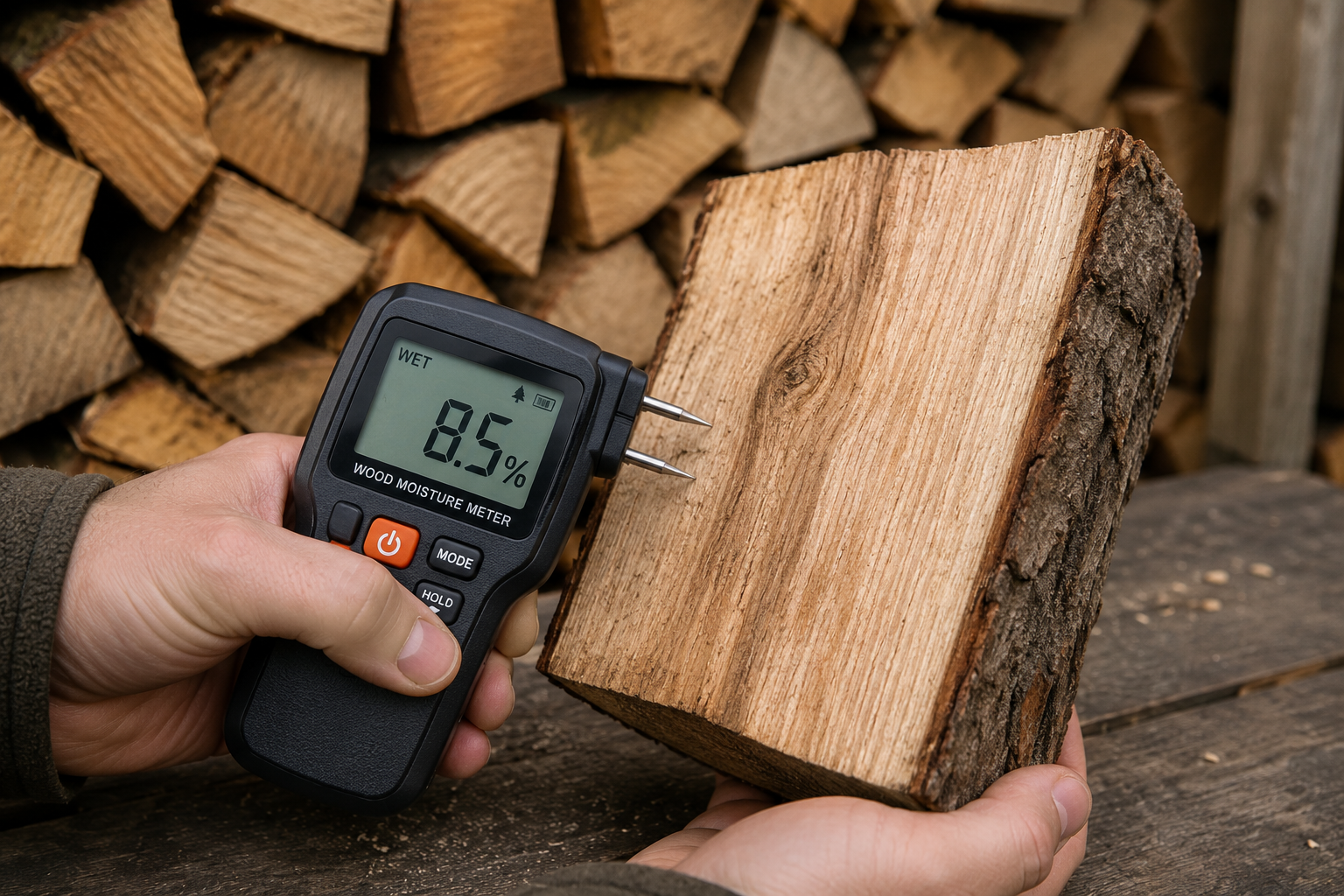
That's very different from us simply splitting a convenient log in the yard, sticking a handheld moisture meter into it and taking a photograph for the website.
Can I test my own firewood at home?
Yes. A handheld moisture meter can be useful for checking your logs at home.
Split a log first and take your reading from the freshly exposed internal face, rather than simply testing the dry exterior.
Don't expect a domestic moisture meter to replicate a laboratory test exactly, but it's a useful way of identifying firewood that's excessively wet.
Why can properly dried firewood feel surprisingly light?
Because water is heavy.
As timber dries, it loses water and therefore loses weight.
So a light log isn't automatically evidence that you've received poor-quality firewood. With properly dried timber, lower weight can simply reflect the fact that much of the unwanted moisture has already been removed.
What ultimately matters is how dry the wood is and how it performs on your fire.
Does dry firewood produce more useful heat?
Drying doesn't magically add energy to the timber.
What it does is reduce the amount of water that has to be dealt with during combustion.
That means more of the energy available from your fire can contribute to useful heat rather than being wasted dealing with excess moisture.
Does burning dry wood matter for smoke too?
Yes.
Ireland's solid-fuel regulations are intended to limit pollutants from domestic solid-fuel combustion and improve air quality. The EPA identifies moisture content as one of the requirements that wood products must meet to qualify as an approved solid fuel.
Good fuel still needs to be used in a suitable, correctly operated and maintained appliance — dry wood isn't an excuse for poor burning practices.
Should I ask a firewood supplier about moisture content?
Absolutely.
If someone is selling you firewood for immediate burning, “How dry is it?” is a perfectly reasonable question.
And we'd go one further:
Ask how they know.
There's a big difference between saying wood is dry and having evidence showing what has actually been tested.
What should I look for when buying firewood after 1 September?
Price will always matter, but it shouldn't be the only comparison.
Look at:
Moisture content. Quality. Log size. Quantity. Delivery. And who you're buying from.
The EPA says retailers must ensure solid fuel is sourced from a registered producer and is an approved solid fuel. Producers are also subject to registration and certification requirements.
A cheap load of wet firewood isn't much of a bargain.
Ready for September 2026
For Surefire Wood, the move to a less-than-20% moisture requirement isn't about suddenly changing the way we dry our firewood to scrape under a new limit.
Our July 2026 Woodsure laboratory testing recorded:
8.16% average moisture — Force Dried Hardwood
10.06% average moisture — Force Dried Softwood
6.0% average moisture — Kindling
All passed.
For our customers, that's the important part.
You shouldn't have to guess whether the firewood you're buying is properly dry.
And from 1 September 2026, the law is setting a considerably clearer standard too